
Rail or Rail-Free? Evaluating the Best Mounting Approach for Tile Roof Solar Projects
June 06, 2026
Tile roof solar installations require more engineering consideration than simply attaching modules above an existing surface. The mounting structure must work with the roof’s geometry, protect fragile tiles, transfer mechanical loads safely, and provide a reliable foundation for decades of energy production.
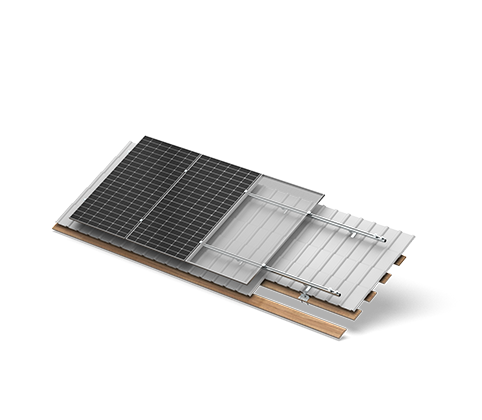
One of the key design decisions in these projects is choosing between rail-less and rail-less mounting approaches. Both methods can secure photovoltaic modules effectively, but they solve different installation challenges. The right choice depends on roof conditions, project complexity, environmental loads, and the expectations for future maintenance.
For installers and developers, understanding how each approach performs in real tile roof applications is essential when selecting a tile roof solar mounting system that delivers both installation efficiency and long-term reliability.
Why Tile Roof Projects Require a More Detailed Mounting Strategy
Tile roofs are not uniform surfaces. Compared with metal or flat roofs, they contain individual tiles, varying profiles, and attachment limitations that require careful planning before installation begins.
The mounting structure does not connect directly to the visible tile surface alone. Instead, it must transfer loads through roof attachments into the underlying structure while minimizing pressure on the tiles themselves.
This creates a challenge for installers: the system needs enough flexibility to adapt to roof conditions while maintaining precise module positioning. A solution that works well on a simple new roof may not perform the same way on an older roof with uneven tile placement or irregular structural spacing.
Rail-less and rail-less systems approach this challenge differently, and the differences become clear during installation.
How Rail-Less Systems Handle Complex Tile Roof Conditions
Rail-less mounting systems use continuous aluminum rails to create a supporting framework between roof attachments and solar modules. This design provides installers with more adjustment capability during array installation.
Tile roofs often have small variations in surface height because of tile manufacturing differences, roof age, or construction tolerances. Rails help compensate for these variations by creating a consistent plane where modules can be aligned properly.
This flexibility is particularly useful for larger installations. When multiple rows of modules need to maintain a uniform appearance, rails provide a reference structure that helps installers achieve accurate positioning.
Another important advantage is load distribution. A rail-less tile roof solar mounting system spreads mechanical forces across multiple attachment points, helping manage wind and snow loads more effectively in demanding environments.
Rails also provide a convenient structure for cable routing. Module cables can be secured along the mounting framework instead of resting near tiles, reducing the possibility of movement or contact damage.
Where Rail-Less Systems May Add Complexity
The flexibility of rail-less mounting comes with additional components. Rails, connectors, and related hardware increase the amount of material that must be transported and installed.
For smaller projects with straightforward roof layouts, this additional structure may not always provide a significant advantage. Installers need to spend more time positioning and securing rails before modules can be attached.
The higher profile created by rails may also influence aesthetic preferences. Some building owners prefer solar modules to sit closer to the roof surface, especially on visible residential or architectural projects.
However, these considerations are usually balanced against the benefits of easier adjustment and greater installation tolerance.
Why Some Projects Choose Rail-Less Tile Roof Mounting
Rail-less systems remove the continuous rail layer and attach modules directly to roof-mounted attachments. This creates a simpler connection path between the roof structure and photovoltaic modules.
The primary advantage is reduced hardware. Fewer components can simplify transportation, reduce material handling, and potentially shorten installation time when roof conditions are predictable.
For tile roofs with consistent layouts and accurate structural information, rail-less systems can provide an efficient installation method. The lower profile can also create a cleaner visual appearance because modules sit closer to the roof.
A well-designed rail-less tile roof solar mounting system can be especially effective for projects where installers have detailed roof measurements and a clear understanding of attachment locations before beginning work.
The Trade-Offs Behind Rail-Less Installation
The simplicity of rail-less mounting also means fewer opportunities for adjustment. Installers must carefully plan attachment positions because the module layout depends more directly on the accuracy of the initial design.
This can become challenging on older tile roofs or buildings with irregular structures. Small differences in roof geometry may create alignment difficulties that would be easier to correct with rails.
Maintenance planning is another consideration. Rail-less systems can provide efficient installation, but future replacement work requires careful attention to attachment locations and module access.
For projects exposed to strong winds, heavy snow, or complex loading conditions, engineers must verify that the direct attachment approach provides sufficient structural performance.
Comparing Long-Term Practical Performance
The decision between rail-less and rail-less systems should not be based only on installation speed. A solar mounting structure must continue performing after construction is complete.
Rail-less solutions often provide advantages in projects where flexibility, adjustment capability, and long-term service access are priorities. They are commonly preferred for complex rooftops where installation conditions cannot be perfectly predicted.
Rail-less approaches can be valuable when simplicity and reduced component usage are important. They work best when roof conditions, structural information, and installation planning are highly controlled.
At Antaisolar, we focus on evaluating mounting solutions according to real project requirements rather than treating one approach as suitable for every roof. Each tile roof installation has different structural conditions, and the mounting design should reflect those differences.
Selecting the Right Approach for Different Tile Roof Applications
The best choice depends on several engineering factors. Roof condition is one of the first elements to evaluate. A new, uniform tile roof may provide suitable conditions for rail-less installation, while an uneven or complex roof may benefit from rail-less flexibility.
Project scale also influences the decision. Larger arrays often require consistent alignment across many modules, making adjustment capability more valuable.
Climate conditions should also be considered. Regions with higher wind speeds or heavier snow loads require careful analysis of how forces transfer from modules through attachments into the building structure.
Cost is important, but the lowest initial installation expense does not always create the best long-term value. A mounting approach that improves reliability, reduces future service challenges, and protects the roof can provide greater benefits throughout the system lifespan.
Conclusion
Rail-less and rail-less mounting systems represent two different approaches to solving tile roof solar installation challenges. Rail-less designs provide adaptability, alignment control, and stronger flexibility for complex projects, while rail-less solutions offer a streamlined structure for installations with predictable conditions.
The decision should come from understanding the roof, the environment, and the long-term expectations of the solar project. A successful tile roof installation is not defined by using fewer components or the fastest installation process, but by creating a mounting solution that remains reliable throughout decades of operation.
Mounting systems will have to offer better compromises between structural integrity, installation effectiveness, and compatibility with roofs as rooftop solar continues to proliferate in an increasingly varied range of building contexts.
end