
Engineering Single-Axis Solar Trackers: A Technical Guide to Mechanics and Structural Physics
June 09, 2026
Navigating the mechanics of utility-scale photovoltaic infrastructure requires a firm grasp of spatial geometry and structural engineering. We design ground-mounted racking systems to maximize long-term energy generation while enduring harsh environmental conditions.
Understanding the mathematical and physical principles behind array movement is essential for EPC contractors, developers, and structural engineers. This comprehensive resource explores the core mechanics, drive mechanics, and aeroelastic stability factors that govern modern solar racking.
By analyzing the mechanics of single axis solar tracking, engineers can optimize system performance and reduce the levelized cost of energy. We will break down how rotational geometry, intelligent backtracking, and damping mechanisms ensure site adaptability and structural durability.
The primary objective of rotational racking is to minimize the incidence angle between incoming solar rays and the module surface normal vector. Solar elevation, azimuth, and local hour angles dictate the real-time spatial coordinates of the sun.
Single-axis structures typically rotate along a True North-South axis to follow the sun's trajectory from East to West. Mechanically, the rotation angle shifts dynamically throughout the day to match solar altitude and azimuth parameters.
In theoretical formulations, rotation calculations account for solar elevation alongside the solar azimuth angle. Maintaining high structural rigidity along the torque tube ensures that this theoretical angle translates to physical module alignment across long array rows.
Topographical variations introduce complex geometric variables into tracker mechanics. When installing systems across rolling terrain, North-South slope variations affect beam alignment and row elevations.
Modern high-tolerance single axis solar tracking systems accommodate slopes up to twenty percent without requiring intensive land grading. Accommodating terrain slope reduces civil engineering overhead, speeds up construction schedules, and minimizes ground disturbance during installation.
Flexible spherical bearings and articulated mechanical joints allow continuous rotational transmission along non-linear axis lines. These components prevent structural binding and reduce mechanical stress on drive mechanisms when operating across uneven land contours.
During early morning and late afternoon hours, high tilt angles cause adjacent panel rows to cast shadows on one another. Inter-row shading significantly degrades array output and can induce thermal stress on individual solar cells.
To prevent mutual shading, smart controllers execute backtracking routines that temporarily flatten module angles. This motion profile relies on the Ground Coverage Ratio, which measures collector width against row pitch distance.
Advanced electronic controls adjust the target rotational position based on dynamic weather conditions and terrain slopes. On overcast days, systems transition toward a horizontal orientation to capture diffuse sky radiation rather than direct sunlight.
Transforming rotational motor force into smooth structural movement requires robust mechanical drive hardware. Slew drive architectures utilize worm gear mechanisms to deliver high torque and self-locking capabilities under heavy structural loads.
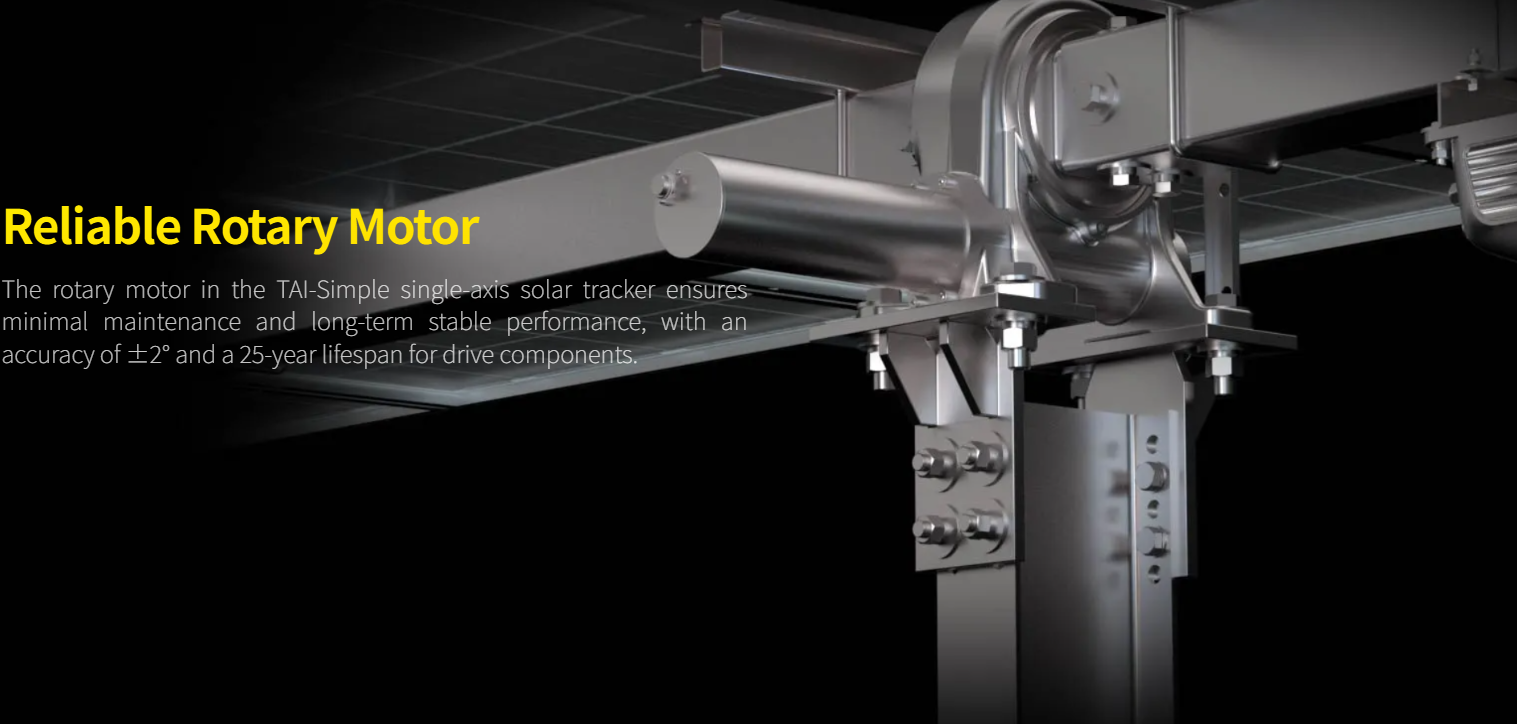
A typical system features a slew-drive rotational motor that provides high torque output with continuous position holding across a wide angular spectrum. A tracking range of up to sixty degrees in either direction maximizes the daily solar energy collection window.
Independent single-row tracking configurations allow each row to operate as a self-contained structural unit supporting large-format high-wattage modules across extended row lengths. This decentralized approach isolates mechanical failures, prevents widespread system downtime, and simplifies ongoing site maintenance routines.
High-precision rotary motors achieve positioning accuracy within two degrees, ensuring consistent energy generation across all operating cycles. Integrated lithium backup batteries maintain emergency power to drive systems during unexpected site power outages.
Solar tracker arrays function as large aerodynamic bluff bodies exposed to atmospheric boundary layer winds. Dynamic wind forces introduce complex torsional loads, static drag, and dangerous aeroelastic flutter phenomena.
Torsional flutter occurs when aerodynamic forces couple with the natural structural frequency of the torque tube. If unmitigated, these resonant vibrations grow exponentially, leading to structural deformation or catastrophic mechanical fatigue.
To combat aeroelastic instability, modern tracking structures incorporate multi-damping systems along the main axis line. Shock absorbers dissipate dynamic energy, preventing uncontrolled oscillation during high wind events up to fifty-five meters per second.
Optimized column layouts lower foundation requirements by up to sixteen percent, reducing pile driving costs while maintaining total structural stability. Pre-assembled components speed up field construction by up to forty-five percent, protecting project schedules.
Utility solar installations must maintain structural integrity across twenty-five to thirty years of continuous outdoor exposure. Selecting durable materials prevents structural corrosion and mechanical degradation in harsh coastal or desert environments.
Zinc-Aluminum-Magnesium coated steel provides self-healing surface protection for torque tubes, mounting purlins, and structural columns. This advanced alloy resists atmospheric corrosion significantly better than conventional hot-dip galvanized steel options.
Smart electronic controllers communicate wirelessly across the site, continuously monitoring structural health and operational status. Automated stow algorithms position array tables horizontally during severe weather to minimize structural lift and drag forces.
Standardized mechanical linkages lower operational maintenance demands over the extended operating life of the solar plant. Reliable physical design paired with intelligent controls delivers high bankability and predictable return on investment for developers.
Applying robust physics and structural mechanics directly drives higher energy yield for commercial and utility power plants. By combining precise kinematic motion with reliable slew drives and multi-damping protection, clean energy installations achieve optimal balance between initial capital expenditure and long-term performance.
As detailed in this guide to single axis solar tracking physics & kinematics, selecting certified racking solutions ensures system stability in demanding environments. Engineering modular components allows rapid deployment across challenging topographies without sacrificing mechanical stability or energy output.
We at Antaisolar continue to engineer high-performance solar tracking systems that combine structural physics, pre-assembled construction, and intelligent control technologies. Our TAI-Simple single-axis solution provides dependable independent tracking engineered to maximize lifetime energy yield and deliver lower levelized cost of energy for utility projects worldwide.
Understanding the mathematical and physical principles behind array movement is essential for EPC contractors, developers, and structural engineers. This comprehensive resource explores the core mechanics, drive mechanics, and aeroelastic stability factors that govern modern solar racking.
By analyzing the mechanics of single axis solar tracking, engineers can optimize system performance and reduce the levelized cost of energy. We will break down how rotational geometry, intelligent backtracking, and damping mechanisms ensure site adaptability and structural durability.
Spatial Vectors and Angular Alignment Mechanics
The primary objective of rotational racking is to minimize the incidence angle between incoming solar rays and the module surface normal vector. Solar elevation, azimuth, and local hour angles dictate the real-time spatial coordinates of the sun.
Single-axis structures typically rotate along a True North-South axis to follow the sun's trajectory from East to West. Mechanically, the rotation angle shifts dynamically throughout the day to match solar altitude and azimuth parameters.
In theoretical formulations, rotation calculations account for solar elevation alongside the solar azimuth angle. Maintaining high structural rigidity along the torque tube ensures that this theoretical angle translates to physical module alignment across long array rows.
The Technical Guide to Single Axis Solar Tracking Physics & Kinematics in Real-World Conditions
Topographical variations introduce complex geometric variables into tracker mechanics. When installing systems across rolling terrain, North-South slope variations affect beam alignment and row elevations.
Modern high-tolerance single axis solar tracking systems accommodate slopes up to twenty percent without requiring intensive land grading. Accommodating terrain slope reduces civil engineering overhead, speeds up construction schedules, and minimizes ground disturbance during installation.
Flexible spherical bearings and articulated mechanical joints allow continuous rotational transmission along non-linear axis lines. These components prevent structural binding and reduce mechanical stress on drive mechanisms when operating across uneven land contours.
Backtracking Algorithms and Shadow Mitigation
During early morning and late afternoon hours, high tilt angles cause adjacent panel rows to cast shadows on one another. Inter-row shading significantly degrades array output and can induce thermal stress on individual solar cells.
To prevent mutual shading, smart controllers execute backtracking routines that temporarily flatten module angles. This motion profile relies on the Ground Coverage Ratio, which measures collector width against row pitch distance.
Advanced electronic controls adjust the target rotational position based on dynamic weather conditions and terrain slopes. On overcast days, systems transition toward a horizontal orientation to capture diffuse sky radiation rather than direct sunlight.
Mechanical Drive Kinematics and Actuation Systems
Transforming rotational motor force into smooth structural movement requires robust mechanical drive hardware. Slew drive architectures utilize worm gear mechanisms to deliver high torque and self-locking capabilities under heavy structural loads.
A typical system features a slew-drive rotational motor that provides high torque output with continuous position holding across a wide angular spectrum. A tracking range of up to sixty degrees in either direction maximizes the daily solar energy collection window.
Independent single-row tracking configurations allow each row to operate as a self-contained structural unit supporting large-format high-wattage modules across extended row lengths. This decentralized approach isolates mechanical failures, prevents widespread system downtime, and simplifies ongoing site maintenance routines.
High-precision rotary motors achieve positioning accuracy within two degrees, ensuring consistent energy generation across all operating cycles. Integrated lithium backup batteries maintain emergency power to drive systems during unexpected site power outages.
Structural Dynamics and Wind Load Mitigation
Solar tracker arrays function as large aerodynamic bluff bodies exposed to atmospheric boundary layer winds. Dynamic wind forces introduce complex torsional loads, static drag, and dangerous aeroelastic flutter phenomena.
Torsional flutter occurs when aerodynamic forces couple with the natural structural frequency of the torque tube. If unmitigated, these resonant vibrations grow exponentially, leading to structural deformation or catastrophic mechanical fatigue.
To combat aeroelastic instability, modern tracking structures incorporate multi-damping systems along the main axis line. Shock absorbers dissipate dynamic energy, preventing uncontrolled oscillation during high wind events up to fifty-five meters per second.
Optimized column layouts lower foundation requirements by up to sixteen percent, reducing pile driving costs while maintaining total structural stability. Pre-assembled components speed up field construction by up to forty-five percent, protecting project schedules.
Advanced Materials and Environmental Endurance
Utility solar installations must maintain structural integrity across twenty-five to thirty years of continuous outdoor exposure. Selecting durable materials prevents structural corrosion and mechanical degradation in harsh coastal or desert environments.
Zinc-Aluminum-Magnesium coated steel provides self-healing surface protection for torque tubes, mounting purlins, and structural columns. This advanced alloy resists atmospheric corrosion significantly better than conventional hot-dip galvanized steel options.
Smart electronic controllers communicate wirelessly across the site, continuously monitoring structural health and operational status. Automated stow algorithms position array tables horizontally during severe weather to minimize structural lift and drag forces.
Standardized mechanical linkages lower operational maintenance demands over the extended operating life of the solar plant. Reliable physical design paired with intelligent controls delivers high bankability and predictable return on investment for developers.
Practical Applications of Single Axis Solar Tracking
Applying robust physics and structural mechanics directly drives higher energy yield for commercial and utility power plants. By combining precise kinematic motion with reliable slew drives and multi-damping protection, clean energy installations achieve optimal balance between initial capital expenditure and long-term performance.
As detailed in this guide to single axis solar tracking physics & kinematics, selecting certified racking solutions ensures system stability in demanding environments. Engineering modular components allows rapid deployment across challenging topographies without sacrificing mechanical stability or energy output.
We at Antaisolar continue to engineer high-performance solar tracking systems that combine structural physics, pre-assembled construction, and intelligent control technologies. Our TAI-Simple single-axis solution provides dependable independent tracking engineered to maximize lifetime energy yield and deliver lower levelized cost of energy for utility projects worldwide.
end